

Small business grants have a reputation as free money, and that reputation causes a lot of wasted effort. Grants are not free in the sense of being easy. They are competitive, they come with strings attached, and most of them fund a specific purpose rather than general operating costs. But for owners who match a program’s goals, a grant can pay for research, equipment, training, or expansion without adding debt or giving up equity.
The process tends to follow the same eight stages regardless of who is offering the money, whether it is a federal agency, a state economic development office, a city program, or a private foundation. Understanding the stages helps you decide early whether a grant is worth pursuing and keeps you from scrambling at the deadline.
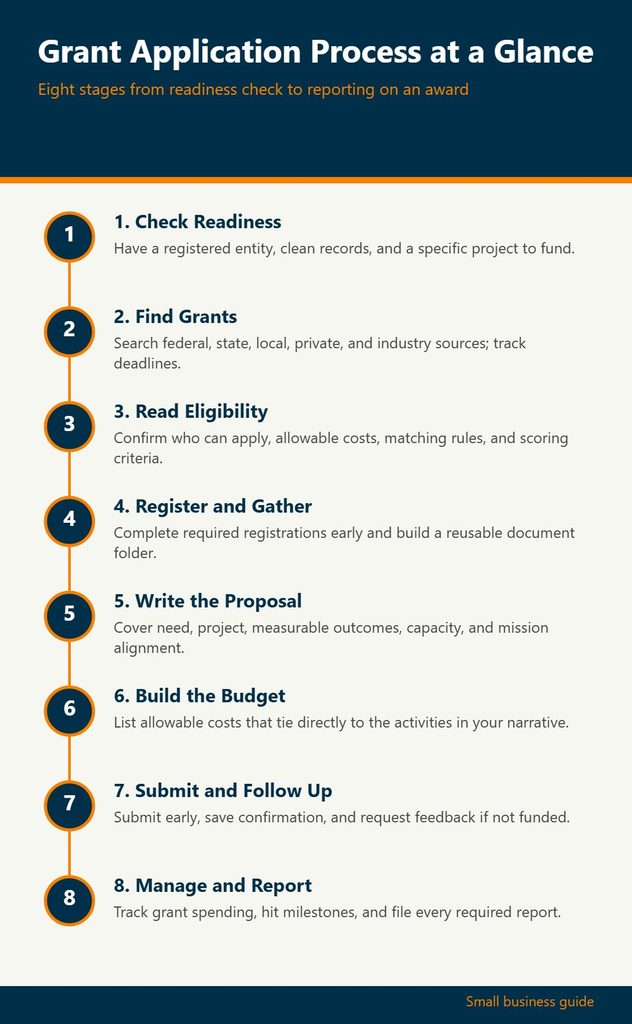
Stage 1: Check Whether You Are Grant-Ready
Before searching for a single opportunity, take an honest look at your business. Funders want to back organizations that can actually carry out the work they pay for. That usually means a registered legal entity, a business bank account, clean financial records, and a clear sense of what you would do with the money.
Ask yourself three questions:
- Do I have a specific project? “We need money” is not a project. “We want to buy a second kiln to double production and hire two local apprentices” is.
- Can I document my business? Expect to provide formation documents, tax returns, financial statements, and sometimes proof of ownership demographics or location.
- Do I have time? A strong application can take dozens of hours. If you cannot spare that time, a loan or other financing may be more efficient.
If the answers are shaky, spend a few weeks tightening your bookkeeping and defining your project first. It will make every later stage faster.
Stage 2: Find Grants You Might Qualify For
Grant opportunities are scattered across many sources, and no single database covers them all. Common places to look include:
- Grants.gov, the central listing for U.S. federal grant opportunities. Note that most federal grants go to nonprofits, research institutions, and governments rather than ordinary for-profit businesses, though some programs do fund small companies.
- SBIR and STTR programs, which fund small businesses doing research and development with commercial potential through participating federal agencies.
- State and local economic development agencies, which often run grants tied to job creation, facade improvements, workforce training, or businesses in particular regions.
- Private and corporate programs, including foundations and companies that offer grants to small businesses, sometimes focused on specific founder groups or industries.
- Industry associations and chambers of commerce, which may know about smaller, less advertised programs.
Your local Small Business Development Center can also help you identify relevant programs. Keep a simple spreadsheet of every opportunity with its deadline, award size, eligibility summary, and link, so you can compare them side by side. GrowBizLab maintains guides on where small businesses can look for grant funding and how to judge whether a program is a fit, and you can find those resources on its official website as you build your shortlist.
One warning: legitimate grants do not require you to pay a fee to apply or to “unlock” an award. Be very wary of anyone who contacts you out of the blue promising a guaranteed grant in exchange for a processing charge.
Stage 3: Read the Eligibility Rules Carefully
This is the stage that saves the most time, yet many applicants rush it. Every grant has a funding notice, request for proposals, or program guidelines document. Read the whole thing before you write a word. Look for:
- Who can apply, including entity type, business size, location, industry, years in operation, and ownership requirements.
- What the money can and cannot be used for. Many grants exclude general operating costs, debt repayment, or purchases made before the award.
- Whether matching funds are required, meaning you must contribute some of your own money or in-kind resources.
- How applications are scored, often listed as evaluation criteria with point values.
- Deadlines, submission format, and page or word limits.
If you do not clearly qualify, move on. If something is ambiguous, most programs list a contact person or hold informational sessions where you can ask questions directly.
Stage 4: Register and Gather Your Documents
Many programs require registrations that take time to complete, so start early. For U.S. federal grants, organizations typically need to register in SAM.gov, which issues a Unique Entity ID, and then set up access on Grants.gov. Registration can take several weeks if information needs to be verified, so do not leave it until the week of the deadline.
Build a reusable folder of documents you are likely to need repeatedly:
- Formation documents and any state registrations
- Your EIN confirmation
- Recent business and sometimes personal tax returns
- Profit and loss statements and a balance sheet
- A current business plan or executive summary
- Resumes or bios for key team members
- Licenses, certifications, and letters of support from partners or customers
Once this folder exists, each new application becomes noticeably faster.
Stage 5: Write a Focused Proposal
The proposal, sometimes called a narrative, is where you persuade reviewers that your project deserves funding. Structure it around the funder’s own evaluation criteria, using their headings where possible, so reviewers can easily find what they are scoring.
Strong proposals usually cover:
- The need or problem. What gap does your project address, and for whom?
- The project. What exactly will you do, step by step, and over what timeline?
- The outcomes. What will be different when the project is complete? Use measurable goals, such as jobs created, units produced, or customers served.
- Your capacity. Why is your business qualified to deliver? Mention relevant experience, partnerships, and past results.
- Alignment. How does the project match the funder’s stated mission?
Write plainly. Reviewers often read many applications in a short time, and clear, specific writing beats impressive-sounding vagueness. Have someone outside your business read the draft and tell you what they think the project is. If they cannot explain it back, revise.
Stage 6: Build a Realistic Budget
The budget is not an afterthought. Reviewers check it closely to see whether your plan is realistic and whether you understand the costs involved. List each expense, explain how you calculated it, and make sure every line connects to an activity described in your narrative.
Common budget categories include personnel, equipment, supplies, contractors, travel, and training. If the program requires matching funds, show where they come from. Stick strictly to allowable costs from the guidelines, since including an excluded item can hurt your score or disqualify the application. Many programs also ask for a budget justification, a short narrative explaining each line.
Stage 7: Submit and Follow Up
Submit early. Online portals can slow down near deadlines, and technical problems are rarely accepted as an excuse. Before submitting, run through a checklist: every required section included, page limits respected, documents in the requested format, signatures where needed, and the correct file names if specified.
After submission, save the confirmation and note when decisions are expected. Some programs take months. If you are not funded, ask whether reviewer feedback is available. Many applicants win on a second or third attempt by addressing the weaknesses reviewers identified. If you want a checklist to use before you hit submit, GrowBizLab publishes practical grant-application checklists alongside its other funding guides; go here to find them and adapt one to your program.
Stage 8: Manage the Award and Report
Winning is not the end. Most grants come with an agreement that spells out how money must be spent, what records you must keep, and what reports you must file. Some pay in installments tied to milestones, while others reimburse expenses after you incur them, which means you may need cash on hand to cover costs first.
Set up a separate accounting category or even a separate account for grant funds. Track every expense with receipts, document progress toward your stated outcomes, and calendar each reporting deadline. Funders may audit how money was used, and misuse can require repayment. Grant income may also have tax consequences depending on the program and your situation, so confirm the treatment with an accountant.
Good reporting also builds a reputation. Funders talk to one another, and a business that delivered on its promises is better positioned for future awards.
Building a Year-Round Grant Routine
Owners who win grants consistently rarely treat them as one-off events. Instead, they build a light routine that keeps them ready. A practical version looks like this:
- Monthly: spend an hour scanning grant listings, newsletters from your state economic development office, and announcements from industry groups. Add anything promising to your tracking spreadsheet.
- Quarterly: update your document folder with the latest financial statements, refresh team bios, and revise your standard project descriptions so they reflect current results.
- Annually: review which applications succeeded and which did not, note the patterns in reviewer feedback, and decide which programs are worth reapplying to.
Keeping a library of reusable text helps too. Descriptions of your company history, mission, team, and past results can be adapted for each application rather than written from scratch, which leaves more time for the parts that must be tailored, such as the project plan and budget.
Mistakes That Sink Otherwise Good Applications
- Applying to everything. Spreading effort across poorly matched grants produces weak applications. Fewer, better-targeted applications usually win more.
- Ignoring the scoring criteria. If reviewers cannot find what they are looking for, they cannot award points for it.
- Vague outcomes. “Grow the business” is not measurable. Specific, realistic targets are far more convincing.
- Last-minute registration. Federal and some state registrations can take weeks.
- Budgets that do not match the narrative. Every dollar should connect to an activity you described.
Grants reward preparation more than luck. Owners who keep their records clean, maintain a document folder, and track opportunities steadily throughout the year are the ones who are ready when the right program opens. Treat each application as practice, learn from the feedback, and the process becomes faster and more successful over time.